
Lymphaticovenous anastomosis (LVA) – supermicrosurgery
The key facts
|
|
|
|
|
Lymphoedema after cancer treatment – what is it and what options are available?
Lymphoedema is a palpable and visible swelling that usually occurs on the arms, legs or torso. It occurs when the lymphatic system is no longer functioning properly. This can happen after cancer treatment, such as surgery to remove lymph nodes or radiotherapy. This is referred to as secondary lymphoedema.
Unlike other temporary types of swelling (e.g. following injury or due to heart or kidney disease), lymphoedema is always caused by a permanent malfunction in lymph drainage. The fluid accumulates in the tissue – often gradually, but with increasing discomfort.
The most important treatment consists of compression (e.g. through specially fitted stockings) and regular lymphatic drainage. In certain cases – depending on the cause and severity, a surgical procedure may also help. This involves either fat removal (liposuction) or microsurgical procedures that can create new drainage pathways for the lymph.
During our lymphatic surgery consultation, we will carefully determine which treatment is best suited to your needs. To do this, we use modern imaging with what is known as ICG lymphangiography to accurately assess the function of your lymphatic system.
About the treatment
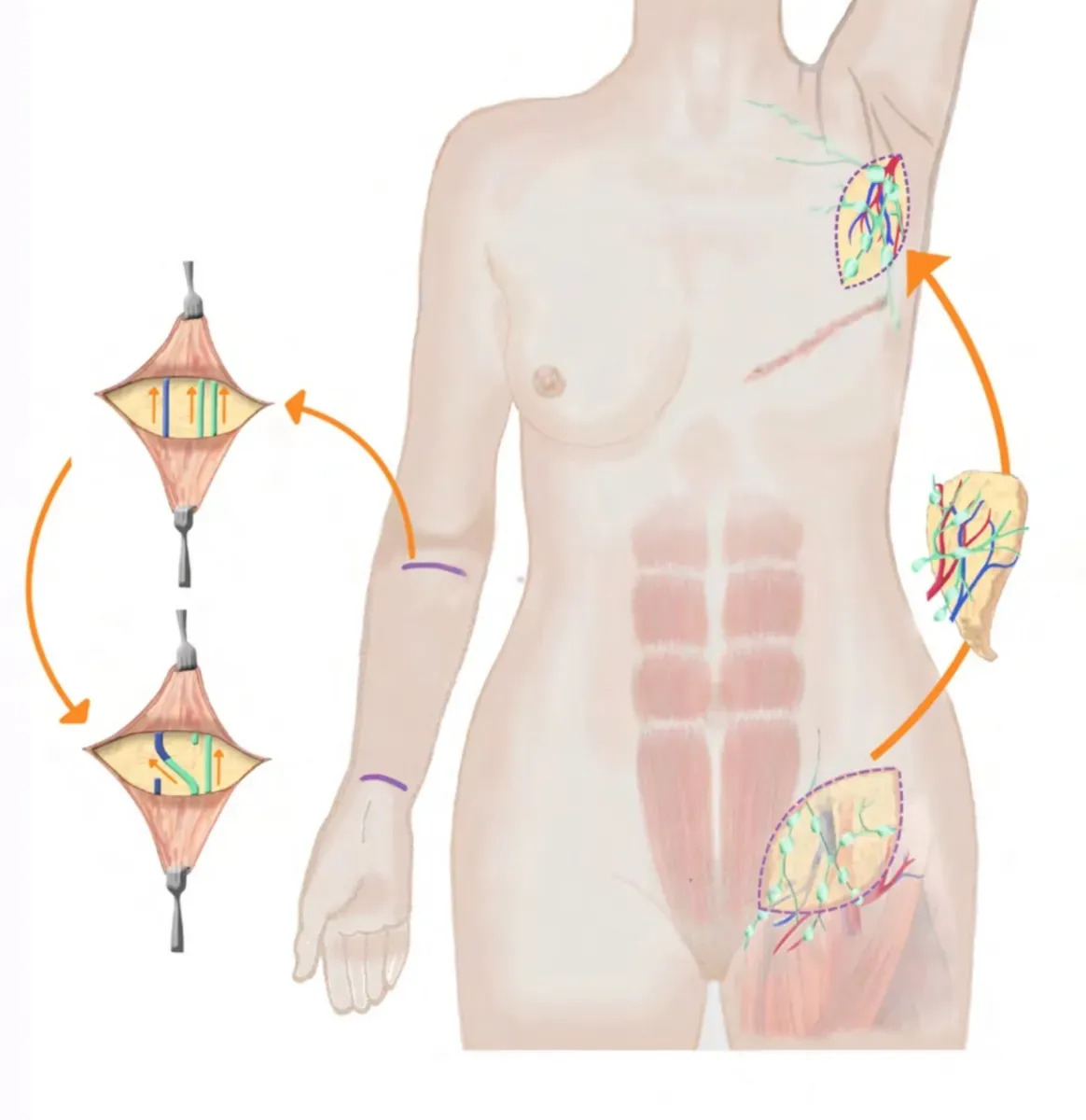
In a procedure called LVA surgery (lymphaticovenous anastomosis), the aim is to surgically improve the impaired lymph drainage. This involves connecting the smallest lymph vessels to neighbouring veins so that the accumulated lymph fluid can drain away via the veins. These connections are made under an operating microscope using extremely intricate instruments – this is why it is referred to as a "supermicrosurgical" technique.
To ensure that the barely visible lymph vessels can be reliably located during the operation, a special dye (indocyanine green, ICG) is injected under the skin. This dye is absorbed by the lymphatic system and makes the vessels visible under a special infrared camera – without any exposure to radiation. The same technology is in fact used before the procedure in order to closely examine how your lymphatic system is functioning.
This method delivers particularly good results for patients who have been experiencing lymphoedema for less than five years. In many cases, a significant reduction in swelling can be observed immediately after the operation.
We will discuss with you whether this procedure is viable for you during our specialist lymphatic surgery consultation.
Typical areas of application
- Early-stage lymphoedema (ideally present for less than 5 years)
- Mild to moderate lymphoedema of the arms or legs
- Lymphoedema following cancer treatment, e.g. following breast cancer or gynaecological tumours
- Where lymph vessels are still functional and flowing (verified by ICG lymphangiography)
- Recurring inflammation (e.g. erysipelas) caused by clogged lymphatic system
- Patient wishes to supplement conservative therapy (compression, lymphatic drainage) with surgery
When is it recommended?
- For early-stage or non-chronic lymphoedema
- When conservative measures alone are not enough
- If there is sufficient access to veins in the affected region
- For patients who require less compression
- As a preventive measure, e.g. at the same time as lymph node removal (in specialist centres)
- In combination with lymph node transfer for added impact
“Lymphoedema is restrictive not only the body, but also on a patient’s life. With innovative lymphatic surgery, we can help to significantly reduce this burden."
FAQs
Will the swelling improve immediately after the operation?
In many cases, a slight improvement can be seen shortly after the procedure. However, the full effect often takes several weeks or months to develop.
Do I still need to keep wearing compression stockings after the operation?
Yes, at least in the initial period after the operation. We decide on a case-by-case basis whether and when you can stop wearing compression stockings, depending on progress.
Will there be a visible scar?
The incisions are very small and generally heal discreetly. The scars are usually barely visible.
Is surgery even an option given my diagnosis?
Whether or not LVA surgery is appropriate for you depends on several factors – for example, the severity of your lymphoedema, how long you have had it and how well your lymphatic system is still functioning. During our lymphatic surgery consultation, we will examine you thoroughly, perform special imaging (ICG lymphangiography) and then discuss with you whether the procedure is suitable for you.

Booking options
