
Breast reconstruction with patient’s own tissue – natural and individual
The key facts
|
|
|
|
|
About the treatment
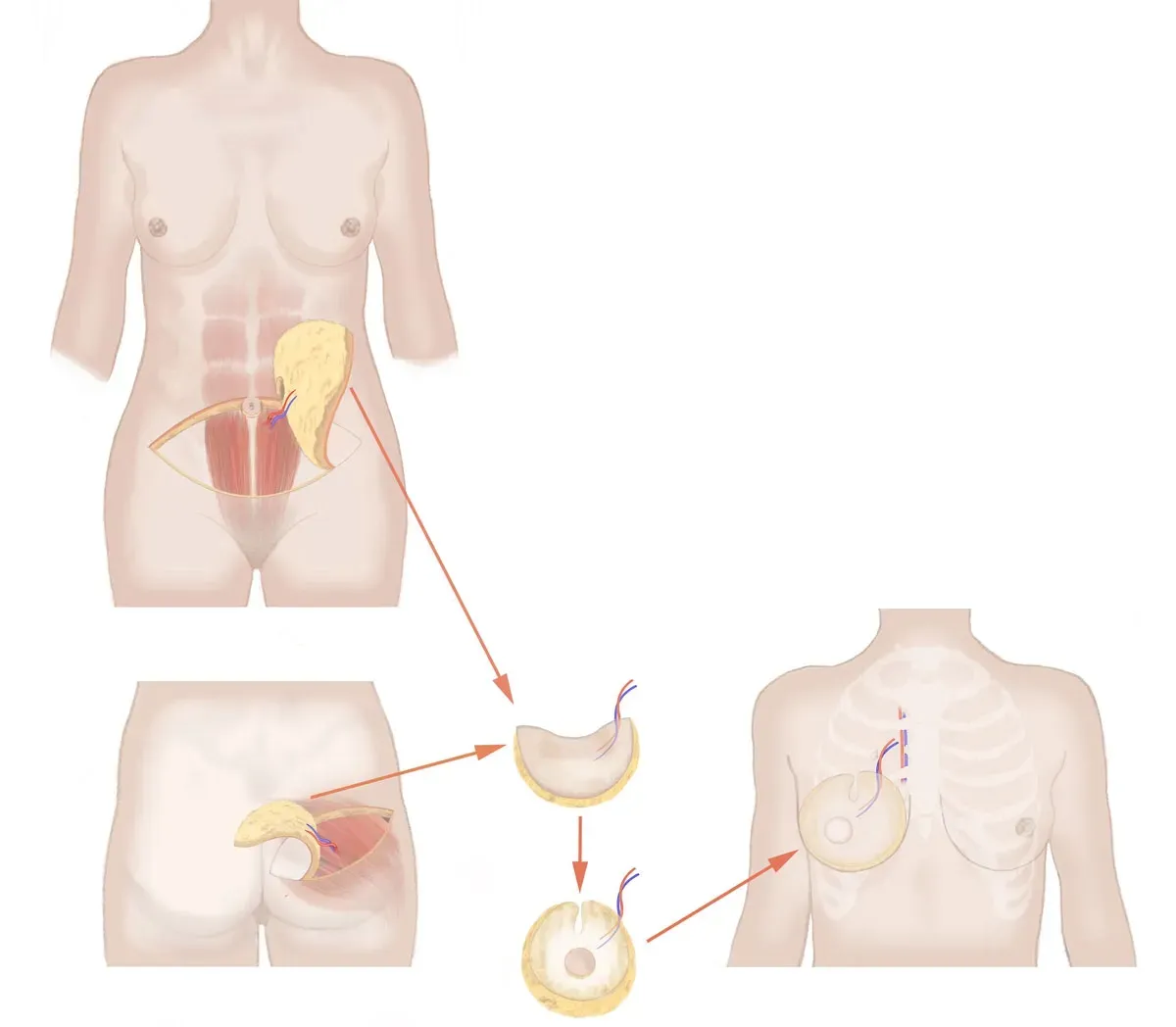
In breast reconstruction using your own tissue, your new breast is formed from tissue taken from another part of your body – for example, your abdomen, buttocks or thighs. The major advantage: No implant is required. Your breast consists entirely of your own tissue, giving it a particularly natural feel.
We remove the tissue from areas where there is excess. An added benefit of this is that the body shape can be harmoniously optimised at the same time.
With nearly 200 procedures performed each year, we have extensive experience in this field and will support you with a high level of professional expertise and sensitivity.
Breast reconstruction using tissue from the abdomen (DIEP flap) – natural and reliable
Breast reconstruction using tissue from the abdomen is the most commonly used method of breast reconstruction. The fat and skin tissue from the lower abdomen is particularly suitable – even for bilateral reconstructions – as it is soft, it moulds well and is very similar to natural breast tissue.
Tissue is removed from the lower abdomen in a process similar to a cosmetic tummy tuck. A fine and easily concealed scar is left in the lower abdominal area, and the navel is repositioned. A major advantage of this method: The abdominal muscles remain completely intact – so your abdominal wall is not weakened.
The removed tissue is connected to new blood vessels in the breast area under an operating microscope – in a precise microsurgical procedure that allows us to achieve particularly natural and lasting results.
This method combines aesthetic and functional benefits and provides a very natural reconstruction.
Breast reconstruction using tissue from the inner thigh (TMG flap) – a good alternative to the abdomen
If there is insufficient tissue on the abdomen or previous operations prevent tissue from being taken from there, tissue from the inner thigh can be a very good alternative for breast reconstruction. This method is also suitable for unilateral or bilateral breast reconstruction.
The tissue is taken from the inner thigh and then connected to new blood vessels in the breast area under a microscope – a microsurgical procedure for extreme precision.
At the donor site, where the tissue is removed, scars will form similar to those left by a cosmetic thigh lift – with a firming effect as an added benefit.
Breast reconstruction using tissue from the buttocks (SGAP flap) – suitable for slim patients
With this method, the tissue required for breast reconstruction is taken from the upper part of the buttocks. This technique is particularly suitable for slimmer patients who do not have sufficient tissue available on their abdomen or thighs – it can also be used for bilateral breast reconstruction.
The operation is technically demanding, since very fine blood vessels must be connected with precision under a microscope. Thanks to our many years of experience and specialisation in microsurgical procedures, you are in the best of hands for this method.
The scar resembles that of a cosmetic buttock lift and can be easily concealed in the bikini line.
Breast reconstruction using tissue from the back (latissimus dorsi flap)
This method, which is less commonly used in modern practice, is still used in certain cases – for example, when other reconstruction methods are not possible. Tissue from the back – consisting of skin, fat and a small amount of muscle – is used to reconstruct the breast.
With this method, an implant is often also necessary to achieve the desired breast volume. A scar will appear on the back, which can usually be easily concealed under the bra strap.
We will discuss with you individually whether this procedure is suitable for you.
Less common reconstruction procedures using the patient's own tissue
In special cases, we also offer less commonly used options for flap reconstructions, such as the LAP flap, IGAP flap or PAP flap. These techniques use the patient's own tissue from less typical donor regions and are only used when other procedures are not suitable. These procedures are performed with the same high level of care and microsurgical precision.
"Using the finest microsurgery techniques, we combine technology, empathy and aesthetics – so that reconstruction is not only successful but also feels natural."
FAQs
What will my breast(s) feel like afterwards?
A breast reconstructed with your own tissue feels softer and more natural than a breast reconstructed with implants. Since the tissue comes from the patient's own body, it adapts well. However, sensation in the new breast is usually limited at first. In some patients, sensation returns, while in others the breast remains numb.
When can I return to my normal daily routine?
Following reconstruction using your own tissue, you should expect a recovery period of approximately 4 to 6 weeks. During this time, it is important to take it easy physically. Light everyday activities (e.g. walking, minor household chores) can be resumed after a few days to weeks. Depending on your occupation, you may be able to return to work after approximately 4 to 6 weeks. Your treatment team will give you individual recommendations depending on your operation and personal healing process.
Will I be restricted in my sporting activities after the operation?
Yes, temporarily. During the first 6 to 8 weeks, you should refrain from sporting activities, especially anything that puts a lot of strain on the chest area or the donor site (e.g. jogging, weight training, abdominal exercises). After that , a gradual return to sport is possible – often with the support of physiotherapy. In the long term, you will be able to participate in all sports again. Your medical team will support and advise you throughout the process.
Are oncological follow-up checks affected by the reconstruction?
No. Regular follow-up examinations (e.g. palpation, imaging such as ultrasound or MRI) can still be performed reliably after breast reconstruction using the patient's own tissue. The reconstruction has no negative impact on the early detection of a possible recurrence. Many patients find reconstruction emotionally empowering and report an improved quality of life.

Booking options
